
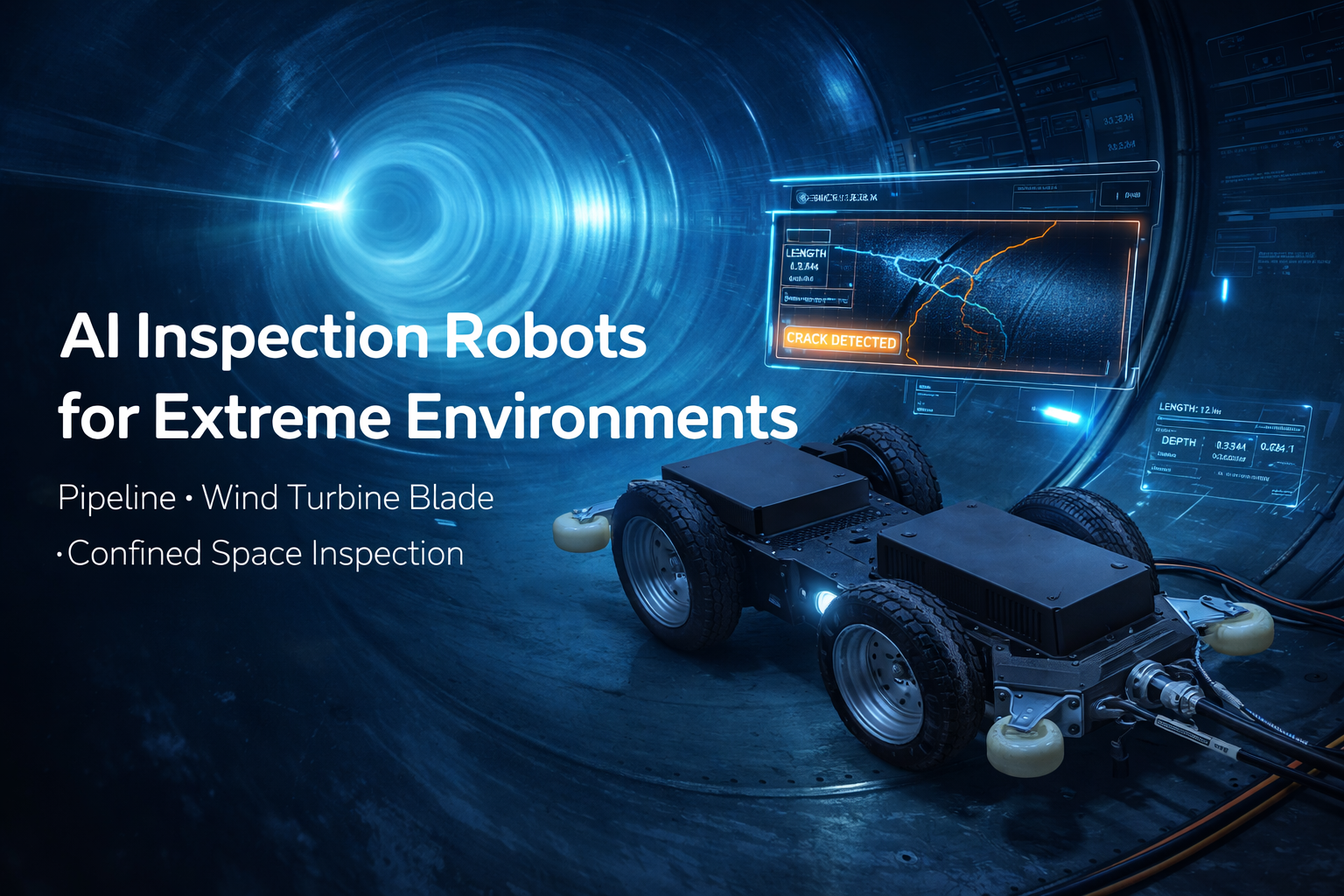
Quick Summary: Advanced Robotic Inspection Solution
The XiaoR Geek 4-Camera Pipeline Inspection Robot is a specialized solution for high-precision maintenance in wind turbine blades, municipal pipelines, and confined industrial spaces. It features a 4-camera 1080P HD visual system, 300-meter remote control range, and a rugged aluminum alloy chassis designed for complex terrains. This robotic crawler significantly enhances safety and efficiency while providing 100GB of onboard storage for detailed defect analysis.
Pipeline Inspection Robot: A Smarter Way to Inspect Industrial Infrastructure
Industrial infrastructure such as pipelines, wind turbine blades, and confined spaces often requires regular inspection to ensure safety and structural integrity. Traditionally, these inspections rely heavily on manual work, which can be dangerous, inefficient, and limited by human accessibility.
Today, advanced technologies such as pipeline inspection robots and wind turbine blade inspection crawlers are transforming how industrial inspections are performed.
These robotic systems provide engineers with high-definition visual data, remote operation capabilities, and enhanced safety, making them essential tools for modern industrial maintenance.
One example is the XiaoR Geek 4-Camera Pipeline Inspection Robot, developed by XiaoR Geek Robot (Shenzhen XiaoR Geek Technology Co., Ltd.), designed specifically for challenging inspection environments.
What Is a Pipeline Inspection Robot?
A pipeline inspection robot is a remotely controlled robotic platform designed to travel through pipelines, tunnels, or confined spaces to collect visual inspection data.
These robots are typically equipped with:
- High-definition cameras
- Lighting systems
- remote control platforms
- real-time video transmission systems
They allow operators to inspect infrastructure without entering hazardous environments, improving both safety and efficiency.
Pipeline inspection robots are widely used in:
- Municipal sewer systems
- Industrial pipelines
- Oil and gas facilities
- Power plants
- Wind turbine blade inspections
Why Wind Turbine Blade Inspection Needs Robots
Modern wind turbines can exceed 80 meters in blade length, and their internal structures are extremely narrow and complex.
Inspecting these structures manually is difficult due to:
- confined internal spaces
- limited visibility
- safety risks
- complex internal geometry
A wind turbine blade inspection robot can move inside the blade structure and provide high-resolution visual data for engineers to analyze potential damage.
Using robotic crawlers significantly improves inspection efficiency and reduces downtime.
Challenges of Confined Space Inspection
Industrial inspections often involve confined spaces such as:
- underground pipelines
- industrial tunnels
- wind turbine blade interiors
- storage tanks
- cable corridors
These environments often have:
- poor lighting
- complex terrain
- signal interference
- limited human accessibility
A robot for confined space inspection must therefore provide reliable mobility, strong communication capability, and high-quality visual systems.
Introducing the XiaoR Geek 4-Camera Inspection Robot
The XiaoR Geek pipeline inspection robot is designed as a remote-controlled inspection platform capable of operating in complex industrial environments.
The robot integrates multiple key systems including:
- four-camera HD inspection system
- wireless remote control platform
- long-distance video transmission
- onboard video recording
- powerful drive system
This design allows inspection teams to obtain multi-angle visual data from areas that would otherwise be difficult or dangerous to access.
Multi-Angle Visual Inspection System
One of the most important features of this inspection robot is its 4-camera HD video system.
The system provides simultaneous visual coverage from:
- top
- front
- left
- right
Each camera delivers 1080P resolution with 12-megapixel imaging capability, ensuring clear inspection of cracks, surface damage, or structural defects.
The cameras also support up-and-down rotation control, allowing operators to adjust viewing angles remotely.
This multi-view configuration is particularly valuable for:
- wind turbine blade internal inspection
- pipeline structural inspection
- confined industrial spaces
Reliable Remote Operation and Control
The robot is equipped with a 2.4G six-channel remote control system designed for industrial inspection environments.
Operators can control the robot’s movement including:
- forward and backward movement
- left and right turning
- differential steering
- variable speed control
The system supports a maximum control distance of 300 meters, allowing operators to remain in safe positions while inspecting difficult environments.
High-Definition Video Transmission and Storage
Inspection data is transmitted through a high-definition video transmission system capable of stable 1080P video return within 150 meters.
The inspection platform includes four-channel video monitoring, enabling simultaneous viewing of all camera feeds.
To support inspection documentation, the system includes:
- 100GB onboard hard drive storage
- real-time recording of all four camera channels
- playback of recorded footage for defect analysis
Storage capacity can also be expanded based on operational requirements.
Mobility and Terrain Adaptation
Industrial inspection environments often involve uneven terrain or structural obstacles.
The XiaoR Geek inspection robot is designed with a high-strength aluminum alloy chassis produced by 3D metal printing and stainless-steel components manufactured through laser cutting and stamping processes.
This robust structure provides durability in demanding inspection conditions.
The robot features four high-power drive motors with anti-stall protection, allowing stable movement even under load.
Key mobility specifications include:
- maximum load capacity: 5 kg
- maximum obstacle height: 4 cm
- maximum climbing angle: 8°
- wheel diameter: 152 mm
- single wheel torque: 17 N·m
These features allow the robot to operate reliably in complex pipeline or confined environments.
Lighting and Inspection Visibility
Inspection environments such as pipelines or wind turbine blades are typically very dark.
The robot integrates LED lighting with 5W illumination power, ensuring clear video capture even in low-light conditions.
This lighting system works together with the HD cameras to deliver high-quality inspection footage.
Key Technical Specifications
The XiaoR pipeline inspection robot includes the following technical specifications:
Robot size: 643 × 260 × 152 mm
Weight: 10 kg
Power supply: AC 220V
Working current: 3A
Maximum speed: 15 cm/s
Camera resolution: 1080P
Camera pixels: 12MP
Camera view angle: 100°
Number of cameras: 4
Control distance: 300 m
Control method: 2.4G six-channel remote control
Video transmission distance: 150 m
Maximum load capacity: 5 kg
Maximum obstacle height: 4 cm
Maximum climbing angle: 8°
Wheel diameter: 152 mm
Wheel torque: 17 N·m
Lighting: LED, 5W
Storage: 100GB hard drive video recording
Applications of Inspection Robots
The XiaoR Geek inspection robot can be used in multiple industrial sectors including:
Municipal infrastructure
Urban sewer systems and underground pipeline inspection.
Energy industry
Wind turbine blade inspection and power plant pipeline monitoring.
Petrochemical industry
Oil and gas pipeline inspection and storage facility monitoring.
Confined industrial environments
Inspection of tunnels, cable corridors, and other restricted spaces.
Why Engineering Teams Choose Inspection Robots
Using robotic inspection platforms offers several advantages compared with traditional manual inspection:
- improved worker safety
- faster inspection processes
- higher inspection accuracy
- reduced operational downtime
- detailed digital inspection records
These advantages make robotic inspection systems increasingly important for modern infrastructure maintenance
Frequently Asked Questions (FAQ) – XiaoR Geek Inspection Robot
Q1: Can the XiaoR Geek inspection robot be used for internal wind turbine blade inspection?
A: Yes. The robot is specifically designed for wind turbine blade interiors. Its compact size (643 × 260 × 152 mm) and multi-angle 4-camera system allow it to navigate narrow internal structures and capture high-definition footage of structural integrity and potential defects.
Q2: What is the maximum control and video transmission distance?
A: The robot supports a stable 2.4G remote control distance of up to 300 meters. The high-definition video transmission system ensures a clear 1080P real-time feed within a range of 150 meters, making it ideal for long-distance pipeline or tunnel inspections.
Q3: How many cameras does the robot have and what is the resolution?
A: The robot is equipped with four 1080P HD cameras (Top, Front, Left, Right). Each camera features 12-megapixel imaging and a 100° viewing angle, providing comprehensive multi-angle visual coverage for thorough inspections.
Q4: Can this robot operate in dark or low-light environments?
A: Absolutely. The system integrates high-power 5W LED lighting, which works in synchronization with the HD cameras to ensure clear visibility and high-quality video recording even in pitch-black pipes or storage tanks.
Q5: What are the mobility limits of the XiaoR Geek inspection crawler?
A: Designed for industrial environments, the robot can climb angles up to 8 degrees, cross obstacles up to 4 cm in height, and carries a maximum load of 5 kg. Its high-torque motors (17 N·m) ensure stable movement on uneven surfaces.
Q6: How is the inspection data stored for later analysis?
A: The robot includes an onboard 100GB hard drive that supports real-time recording of all four camera channels. Engineers can play back the 1080P footage for detailed defect identification and maintenance reporting.
Conclusion
Industrial infrastructure is becoming increasingly complex, and maintaining it safely requires more advanced inspection technologies.
Robotic solutions such as pipeline inspection robots, wind turbine blade inspection crawlers, and robots for confined space inspection are helping engineers perform inspections more safely and efficiently.
The XiaoR Geek inspection robot provides a multi-camera inspection system, long-distance remote control capability, and reliable mobility platform, making it suitable for demanding industrial inspection environments.
For organizations seeking advanced inspection solutions, robotic platforms are becoming an essential tool for modern infrastructure maintenance.